
The Ultimate Guide to
Prambanan Temple: Indonesia’s Towering Masterpiece of Stone, Myth, and History
Everything you need to know about the largest Hindu temple complex in Indonesia — from its 9th-century origins, hidden foundation treasures, and Ramayana reliefs to the legend of Roro Jonggrang, the 2006 earthquake, its festival calendar, and how to experience it today.
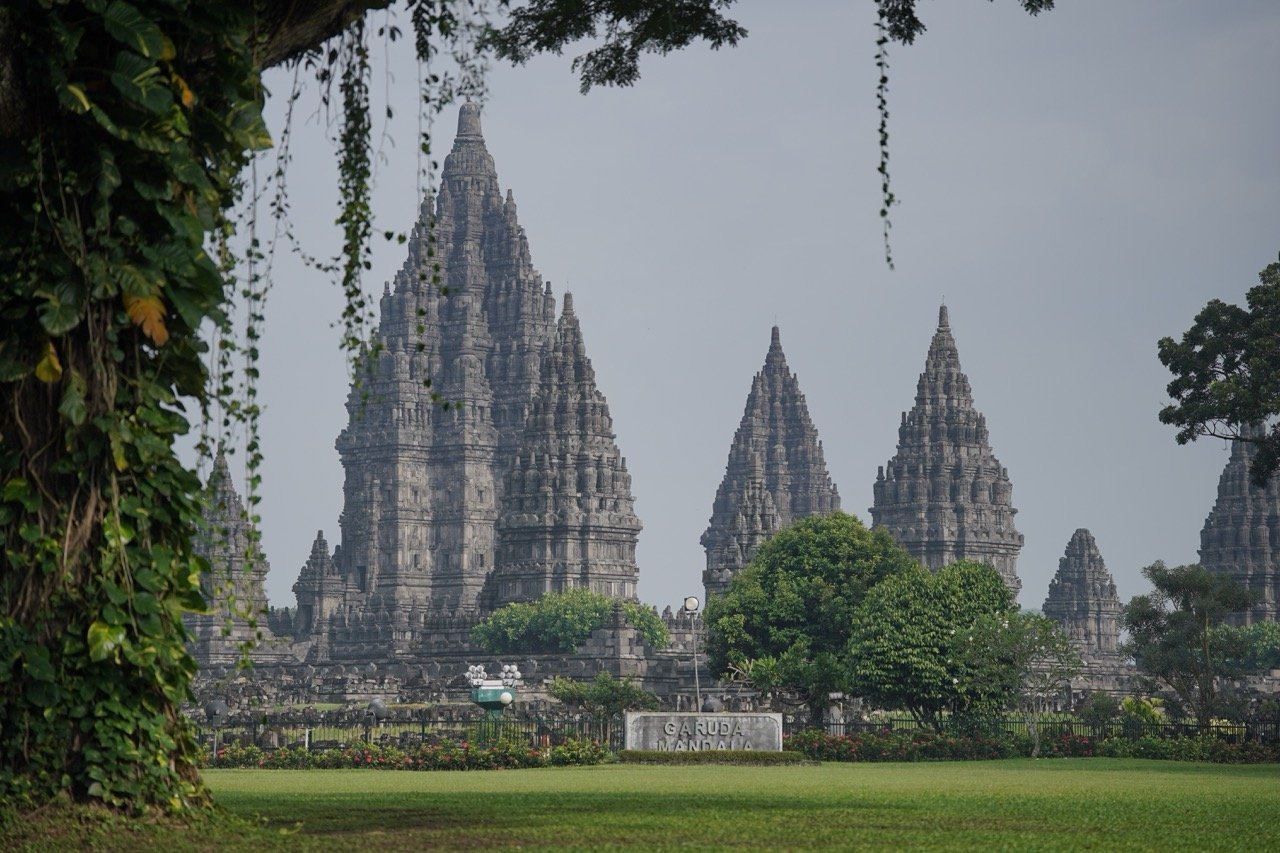
The Prambanan Temple
If you’ve ever typed “Prambanan Temple” into a search bar, you’ve probably seen the postcard-perfect image: three towering stone spires rising above green rice fields, framed by volcanoes in the distance. But Prambanan Temple is far more than a photogenic ruin. It is a 1,100-year-old architectural marvel, a sacred Hindu sanctuary, a canvas of epic stone reliefs, a UNESCO World Heritage Site, and a place where legend and history blur into one unforgettable story.
What most visitors never realize is how much is hidden beneath and behind the stones: a sealed foundation well containing gold and gemstones, a river that was deliberately rerouted to protect the temple, a relief program that switches from the Ramayana to the life of Krishna depending on which temple you circle, and a 240-temple master plan of which only 18 structures still stand. In this super-complete guide, we’ll walk through all of it — plus the festivals, the ticket prices, and the practical details you need before you go.
Prambanan Temple at a Glance
- Original name: Siwagrha (“House of Shiva”), per the Siwagrha Inscription of 856 AD
- Built: From around 850 AD, under Rakai Pikatan of the Sanjaya Dynasty, Medang Mataram Kingdom
- Dedicated to: The Trimurti — Shiva, Vishnu, and Brahma — with Shiva as the supreme deity
- Material: Andesite stone
- Height: 47 meters (Candi Shiva), the tallest structure in the complex
- Original temple count: 240 (16 in the sacred core + 224 perwara temples)
- Still standing: 18 structures
- Orientation: Facing east
- Location: Border of Sleman (Yogyakarta) and Klaten (Central Java), ~17 km northeast of Yogyakarta
- UNESCO World Heritage Site: Inscribed in 1991 (reference no. 642)
- Indonesian national heritage: Designated 1 July 1998
The History of Prambanan Temple: A 9th-Century Power Statement
Prambanan Temple was not built overnight — despite what the legend says. Construction began around 850 AD under King Rakai Pikatan of the Sanjaya Dynasty, part of the Ancient Mataram Kingdom. The project was later continued and expanded by King Lokapala and King Balitung Maha Sambu, cementing Prambanan as the largest Hindu temple complex in Indonesia and the second-largest in Southeast Asia after Angkor Wat.
Historians have long suspected that the construction of this monumental Hindu temple was a deliberate statement: a counterpoint to the Buddhist Borobudur and Sewu temples, and a marker that the Sanjaya family — devotees of Shiva — had reasserted royal patronage after a period in which the Sailendra dynasty leaned heavily toward Mahayana Buddhism. In other words, Prambanan Temple was both a house of worship and a political manifesto carved in andesite.
The Siwagrha Inscription and the River That Was Moved
The Siwagrha Inscription, dated 778 Saka (856 AD), is our key written source. It reveals two remarkable things. First, the temple’s original Sanskrit name was Siwagrha — “House of Shiva” — or Siwalaya, “Realm of Shiva.” Second, and far more surprising: while the temple was under construction, the builders carried out a major hydraulic engineering project to divert the Opak River, which originally flowed from north to south along the western side of the complex.
Archaeologists believe the original channel curved eastward, coming dangerously close to the construction site, where erosion could undermine the foundations. So the builders cut a new, straight north–south channel outside the western wall, then backfilled the old riverbed to create more flat land for the rows of perwara temples. That is 9th-century civil engineering at its finest — a detail that makes Prambanan Temple as much a feat of hydrology as of architecture.
The Etymology: Five Competing Theories
The name “Prambanan” is a puzzle. The most widely accepted theory is that it comes from the village where the temple stands, and may be a Javanese dialect shift of Para Brahman — “the Great Brahman,” the supreme, indescribable reality in Hindu theology. Another reading suggests “Para Brahman” referred to the many Brahmins who once lived around the temple. A third theory traces it to the Javanese root mban, meaning to bear or carry a duty — a nod to the gods who uphold cosmic order.
A fourth, more exotic theory notes that in Khmer, pram means five and banam means mountain — “five mountains,” evoking the five peaks of the Himalayas. A fifth, proposed by J. Groneman in 1887, is charmingly mundane: ramban means “gathering leaves,” so pra-ramban-an would mean a place in the forest where leaves are collected. Whatever the truth, the name stuck — and the sacred original, Siwagrha, was nearly forgotten.
Abandonment and Rediscovery
Around the 930s, the political center of the kingdom shifted to East Java under Mpu Sindok, founder of the Isyana Dynasty. The cause is debated — possibly a massive eruption of Mount Merapi, just 20 km north, possibly war and power struggles. Either way, Prambanan Temple was left unattended, and over centuries it decayed. A major earthquake in the 16th century is believed to have toppled much of it.
Local people never forgot the ruins — they simply explained them through folklore, giving birth to the Roro Jonggrang legend. After the 1755 split of the Mataram Sultanate, the ruins and the nearby Opak River even became the boundary marker between the Yogyakarta Sultanate and the Surakarta Sunanate.
In 1733, a Dutchman named CA. Lons rediscovered the site. Interest grew during the British occupation of Java, when Colin Mackenzie, a surveyor under Sir Thomas Stamford Raffles, examined the ruins. But serious attention came slowly — and the 1880s excavations ironically fueled looting, with carved stones carted off as garden ornaments and locals reusing temple blocks as house foundations.
Restoration: A Century-Long Effort
Proper restoration began in earnest in the 20th century. Theodoor van Erp stabilized fragile sections in 1902–1903. The Archaeological Service (Oudheidkundige Dienst) under P.J. Perquin took a more systematic approach from 1918 to 1926. De Haan continued until his death in 1930, followed by Ir. V.R. van Romondt from 1931 to 1942 — after which leadership passed to Indonesian specialists and continued until 1993.
The restoration of the main Shiva temple was completed in 1953 and inaugurated by Indonesia’s first president, Sukarno. A key rule governs all work here: a temple is only rebuilt if at least 75% of its original stones survive. Because so many stones were stolen or reused, many of the smaller temples will never be reconstructed — their foundations are all that remain.
In 1991, Prambanan Temple Compounds — together with Sewu, Lumbung, and Bubrah — were inscribed as a UNESCO World Heritage Site under criteria (i) and (iv). In 1998, the site was also designated a national cultural heritage area of Indonesia.
In the early 1990s, the government relocated the informal market and settlement that had grown up around the ruins, turning the area into an archaeological park. In 1992, the state-owned enterprise PT Taman Wisata Candi Borobudur, Prambanan, dan Ratu Boko was formed to manage the park — the institutional ancestor of today’s InJourney Destination Management.
Architecture and Layout: A Mandala in Stone
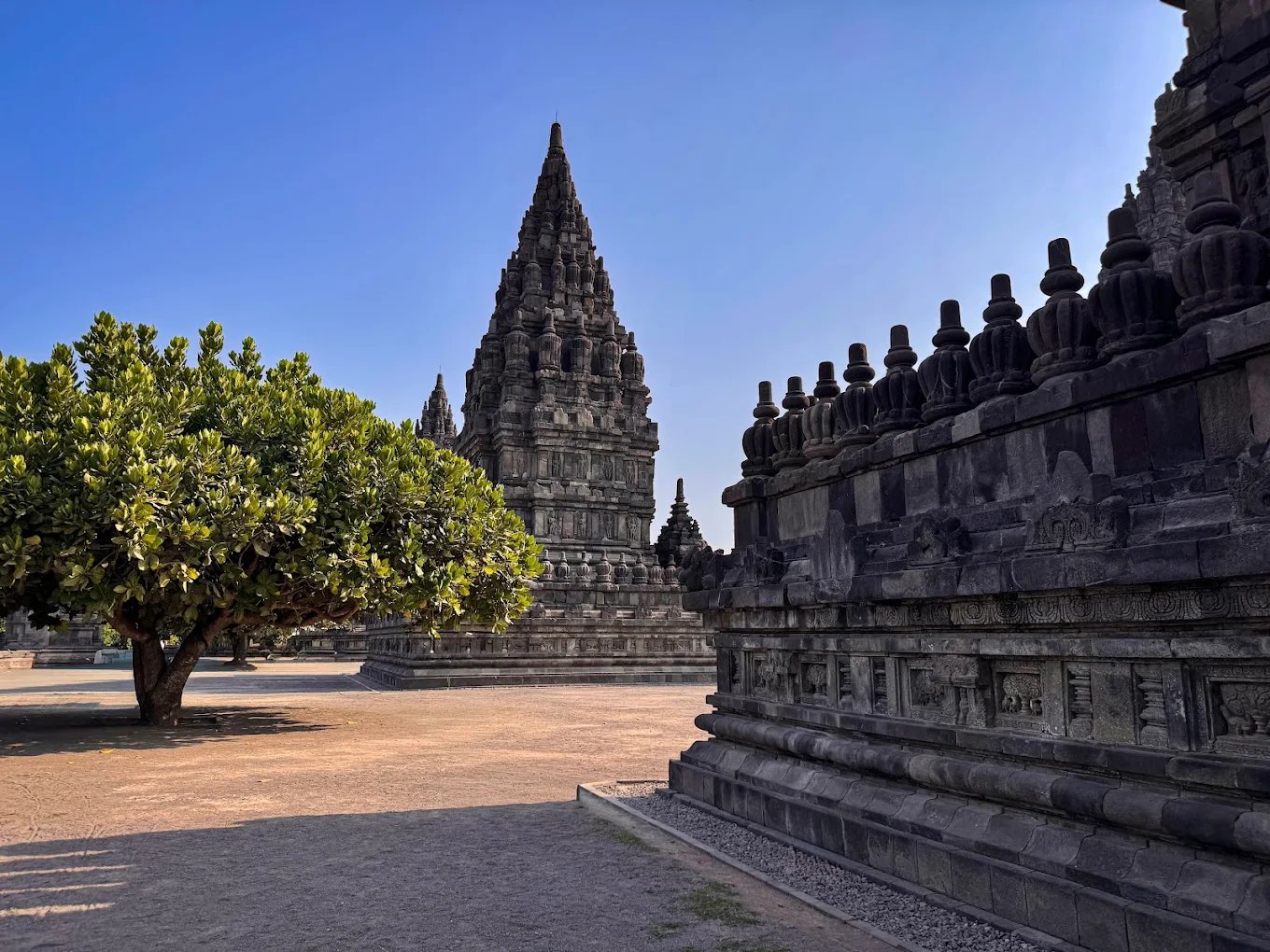
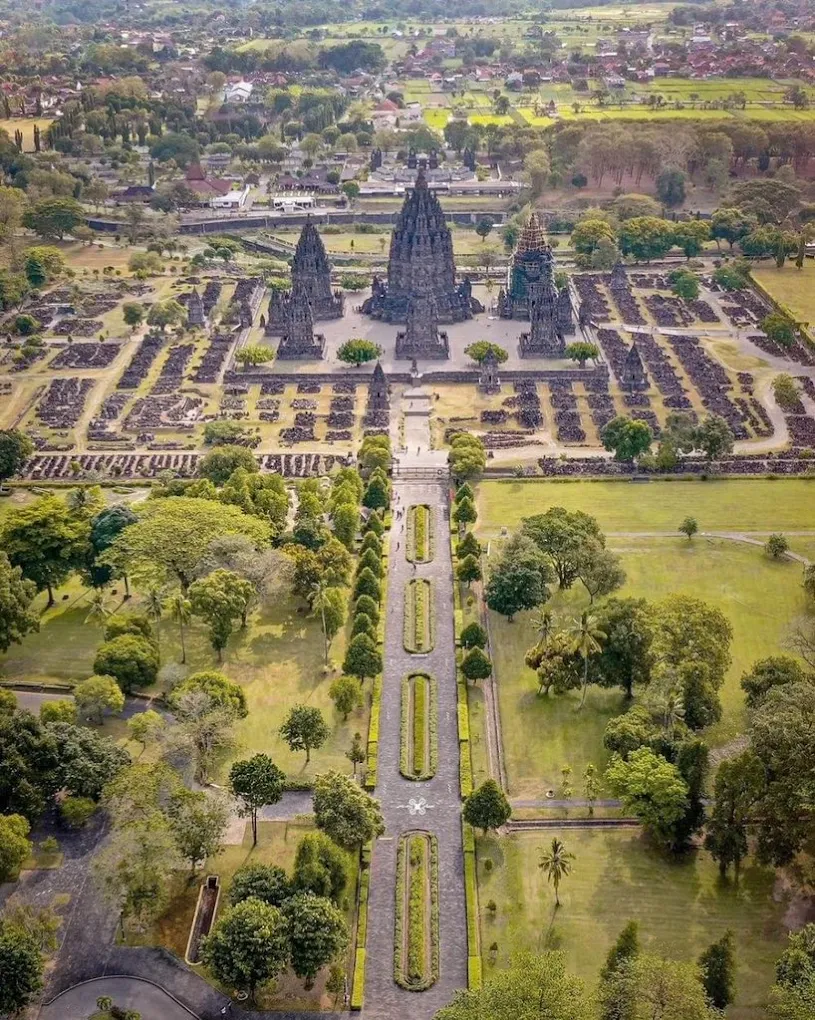
Prambanan Temple follows the classical Hindu architectural tradition laid out in the Wastu Sastra (Silpasastra) texts. The ground plan is a mandala, and the soaring, slender silhouette is a deliberate echo of Mount Mahameru, the sacred abode of the gods. The whole complex is a three-dimensional model of the Hindu cosmos.
The Three Cosmic Zones
Both horizontally and vertically, the complex is divided into three realms — concepts that have direct Buddhist equivalents at Borobudur:
- Bhurloka (Buddhist: Kamadhatu) — the lowest realm of mortal beings, still bound by desire. Represented by the outer courtyard and the base of the temples.
- Bwahloka (Buddhist: Rupadhatu) — the middle realm of sages, ascetics, and lesser deities, where truth begins to be perceived. Represented by the middle courtyard and the body of the temples.
- Swahloka (Buddhist: Arupadhatu) — the highest and holiest realm of the gods and heavenly nymphs. Represented by the inner courtyard and the temple roofs.

The Complete 240-Temple Blueprint
Popular culture calls Prambanan Temple the “Temple of a Thousand,” but the documented original count is exactly 240. Here is the full breakdown — this is the detail almost every travel article skips:
Each perwara temple is 14 meters tall on a 6 × 6 meter base, with one staircase and entrance facing its primary direction — except the 16 corner temples, which have two staircases facing two outward directions. Interestingly, the roofs of the inner-zone temples are crowned with wajra (diamond/thunderbolt) finials, while the perwara roofs carry ratna (jewel) finials. The ratna is the Hindu counterpart of the Buddhist stupa found atop Borobudur.
Scholars have debated what the four rows of perwara temples mean. One theory links them to the four Hindu castes — Brahmana innermost, then Kshatriya, Vaishya, and Shudra outermost. Others argue they were simply places for worship or meditation for priests and pilgrims, financed by regional rulers as offerings to the king.
The outermost courtyard is a 390 × 390 meter square. Its precise function is unknown — possibly a sacred garden, possibly dormitories for Brahmins and their students. Since no stone foundations survive there, any buildings were likely made of wood and have long since rotted away.
Inside the Three Main Temples: Gods, Chambers, and Statues
Candi Shiva: The Five-Chambered Heart
The Shiva temple is 47 meters tall and 34 meters wide — the largest and tallest structure at Prambanan Temple. Uniquely, it contains five chambers: one in each cardinal direction plus the central garbhagriha, the holiest inner sanctum.
In the central chamber stands the monumental Shiva Mahadewa statue, three meters tall. It carries all the classic attributes of Shiva: the chandrakapala (skull above a crescent moon), the jatamakuta (crown of majesty), and the trinetra (third eye) on the forehead. Its four arms hold a prayer bead string (aksamala), a fly-whisk (camara), and a trident (trisula). A cobra forms the sacred thread across its chest, and the god wears a tiger-skin loincloth, complete with carved tiger head, claws, and tail on the thigh. The statue stands on a lotus cushion atop a square yoni base, with a naga carved on its northern side.
Some historians believe this statue is a posthumous portrait of King Balitung — a pedharmaan image in which the deceased king’s soul was understood to reunite with his patron deity, Shiva.
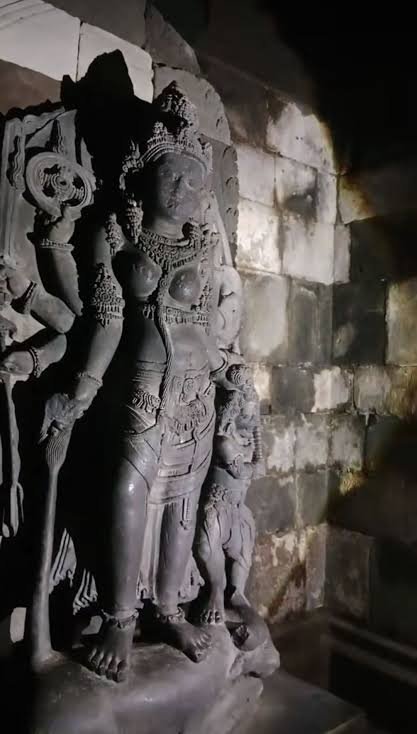
The other chambers house smaller sacred figures: Agastya the sage in the south, Ganesha (Shiva’s elephant-headed son) in the west, and Durga Mahisasuramardini in the north — the goddess slaying the buffalo demon Mahisasura. This Durga statue is the one locals identify as the petrified Roro Jonggrang.
Candi Brahma and Candi Vishnu
Flanking the Shiva temple are two slightly smaller structures, each 33 meters tall and 20 meters wide, with a single chamber. The southern Brahma temple houses a nearly three-meter statue of Brahma the Creator. The northern Vishnu temple houses a statue of Vishnu the Preserver.
The Wahana Temples: Nandi, Hamsa, and Garuda
Directly facing each main temple is a smaller shrine for the god’s mount. In front of Shiva stands the Nandi temple, home to the sacred bull. Flanking the Nandi statue on the rear wall are Chandra (the moon god, standing on a chariot drawn by 10 horses) and Surya (the sun god, on a chariot drawn by 7 horses).
Curiously, the Hamsa temple (for Brahma’s swan) and the Garuda temple (for Vishnu’s eagle) are both empty — no statues survive. The Garuda figure, of course, lives on as Indonesia’s national emblem, Garuda Pancasila.
The Small Shrines: Apit, Kelir, and Patok
The two Candi Apit sit between the Trimurti and Wahana rows and are roughly the size of a perwara temple. The four Candi Kelir and four Candi Patok are miniature temples about 2 meters tall, without staircases. The Kelir function like the aling-aling screen walls in Balinese Hindu temples, and may have held offerings — much like the pelinggih shrines of a Balinese pura.
The Hidden Treasure Beneath the Shiva Statue
Here is one of the most fascinating discoveries at Prambanan Temple. During restoration, excavators digging beneath the Shiva statue in the main chamber found a well 5.75 meters deep. At its bottom lay a stone casket — the pripih, a foundation deposit — resting on layers of charcoal, earth, and animal bones from sacrificial offerings.
Inside the casket were extraordinary sacred objects: gold sheets inscribed with the names Baruna (god of the sea) and Parwata (god of the mountain); copper sheets mixed with charcoal, ash, and earth; 20 ancient coins; gemstones; glass; gold fragments; silver sheets; seashells; and 12 gold sheets — five of them shaped as a turtle, a cobra, a lotus, an altar, and an egg.
This deposit was the spiritual “battery” of the temple, consecrating the ground before the god was installed. It is rarely mentioned in travel guides, but it is one of the most human details of Prambanan Temple — proof that behind the monumental architecture lay quiet, deeply personal ritual.
The Reliefs: Ramayana, Krishnayana, and the Prambanan Panels
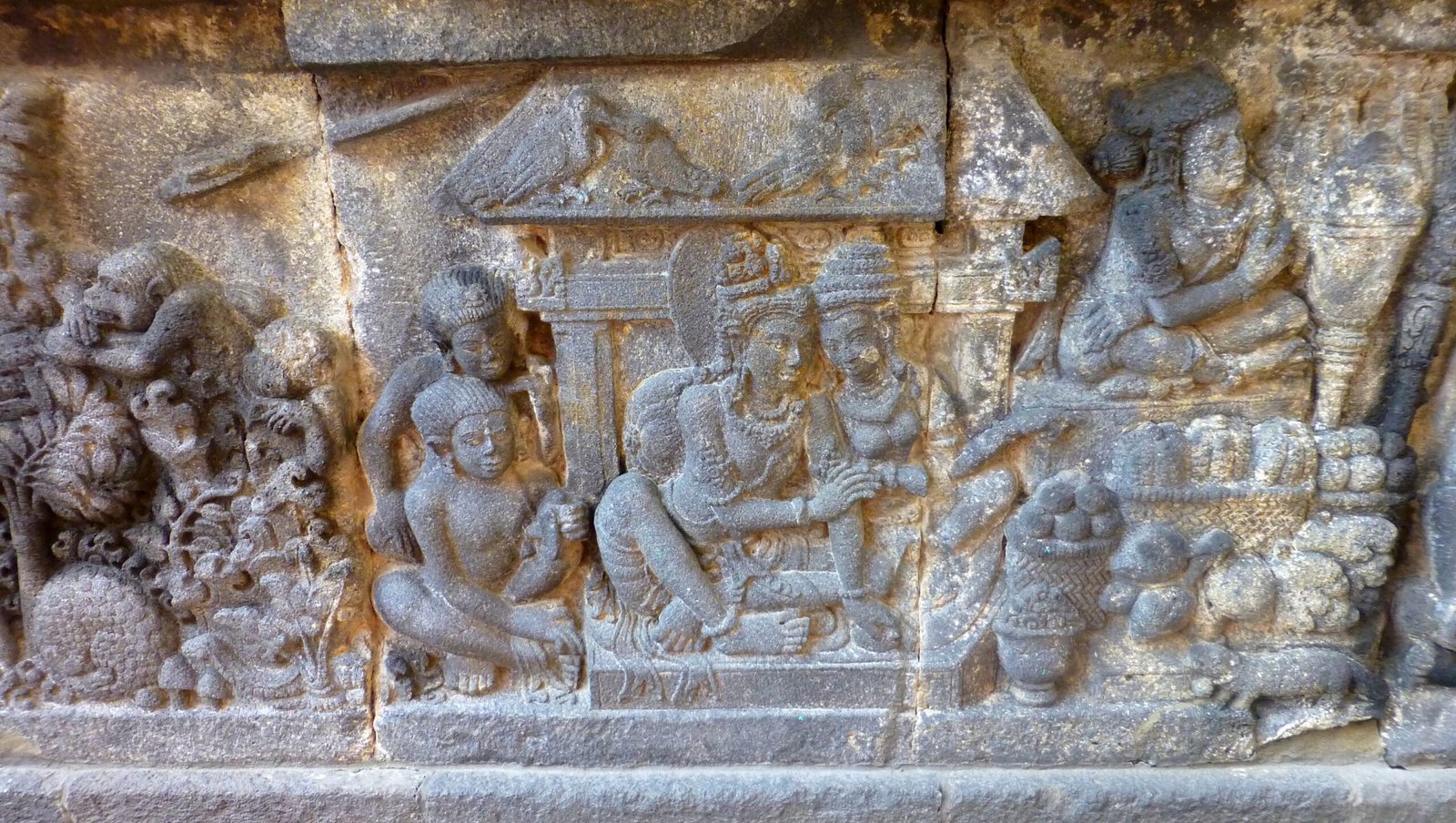
If the architecture of Prambanan Temple is its skeleton, the reliefs are its soul. The narrative panels run along the inner face of the balustrade walls in the galleries surrounding the three main temples. They are read from right to left while walking clockwise — following the pradaksina, the pilgrim’s ritual circumambulation of a sacred structure.
Ramayana on Shiva and Brahma
The Ramayana story begins on the eastern side of the Shiva temple and continues onto the Brahma temple. It depicts Rama’s exile, the abduction of Sita by Rahwana, the arrival of Hanuman and the monkey army, and the building of the causeway to Alengka. The famous panel of Sita being carried off by the winged giant Rahwana, while the bird Jatayu attempts to rescue her, is one of the most reproduced images from the site.
Scholars have long noted that some scenes align more closely with the Malay Hikayat Seri Rama than with the Old Javanese Kakawin Ramayana or Valmiki’s Sanskrit original — evidence that the sculptors were creatively adapting a living, regional epic tradition.
Krishnayana on Vishnu
This is a detail most visitors miss entirely. The Vishnu temple does not continue the Ramayana. Instead, its balustrade carries the Krishnayana — the life story of Krishna, one of Vishnu’s avatars. It is a deliberate theological choice: each temple tells the story most closely associated with its resident deity.
Lokapala, Brahmins, and Apsaras
Above the narrative panels, along the temple body, stand statues and reliefs of gods and holy figures. The Shiva temple features the Lokapala — the guardian deities of the cardinal directions. The Brahma temple features Brahmins, the composers of the Vedas. The Vishnu temple features celestial deities flanked by apsaras, heavenly nymphs.
The “Prambanan Panels”
On the outer lower walls runs a row of niches containing lion statues, each flanked by two panels depicting the Kalpataru, the wish-fulfilling tree of life. At the tree’s base are paired kinnara–kinnari (mythical half-bird, half-human beings) or pairs of animals — birds, deer, sheep, monkeys, horses, elephants. This lion-and-kalpataru arrangement is found only at Prambanan, which is why art historians simply call it the “Prambanan Panel.”
The Legend of Roro Jonggrang: Myth Behind the Stones
No article about Prambanan Temple is complete without the legend of Roro Jonggrang — a tale so deeply woven into local culture that many Javanese grow up believing it is history.
A powerful prince named Bandung Bondowoso fell in love with Roro Jonggrang, daughter of King Ratu Boko. She set an impossible condition: he must build 1,000 temples in a single night. With supernatural genies and spirits, he raced through the construction. As dawn approached, he had completed 999. Desperate, Roro Jonggrang ordered the village women to pound rice and light fires, tricking the spirits into believing morning had come. The genies fled, and the last temple was never finished.
Enraged, Bandung Bondowoso cursed Roro Jonggrang, turning her to stone. Locals say the Durga Mahisasuramardini statue in the Shiva temple’s northern chamber is the petrified princess herself.
The legend is fictional, but it had a real function: it explained the existence of this vast abandoned complex when written records were inaccessible. It even appears in Western literature — Thomas Stamford Raffles’ The History of Java (1817) includes a drawing of the main temple labeled “candi induk di Jongrangan,” using the local name Loro Jonggrang, meaning “Slender Maiden.” That is why the complex is still popularly called Candi Rara Jonggrang.
Whether you see the statue as a goddess or a cursed princess, the legend adds a layer of human emotion to Prambanan Temple that pure archaeology cannot provide.
The 2006 Earthquake: When Prambanan Trembled
On May 27, 2006, a powerful earthquake struck the Bantul region and Yogyakarta. Indonesian authorities recorded a magnitude of 5.9; the United States Geological Survey reported 6.2. The epicenter was on the Opak tectonic fault, whose rupture line follows the Opak River valley right past Prambanan.
Prambanan Temple was hit hard. The complex remained standing overall, but large stone fragments — including carved relief panels — and wajra finials came crashing down. The Brahma temple was among the worst affected. The site was closed to visitors while the damage and collapse risk were assessed; the Yogyakarta Archaeological Office stated that months would be needed to fully understand the extent of the damage.
Within a few weeks, the park reopened for tourism, but restoration was a long game. In January 2009, the restoration of the Nandi temple was completed. That same year, the inner chambers of the main temples were closed to visitors for safety reasons.
The international response was swift: UNESCO, the Japanese government, and Indonesian heritage authorities collaborated on a major rehabilitation program, installing seismographs, researching historical documentation in the Netherlands, and using careful partial dismantlement and reconstruction with traditional techniques and original stones. The 2006 earthquake left a lasting legacy, spurring ongoing research into earthquake-resistant conservation in one of the world’s most seismically active regions.
For context on how popular the site is: in 2008, 856,029 domestic tourists and 114,951 foreign tourists visited Prambanan — a reminder of how much is at stake in protecting it.
Beyond the Main Temples: The Dataran Kewu Landscape
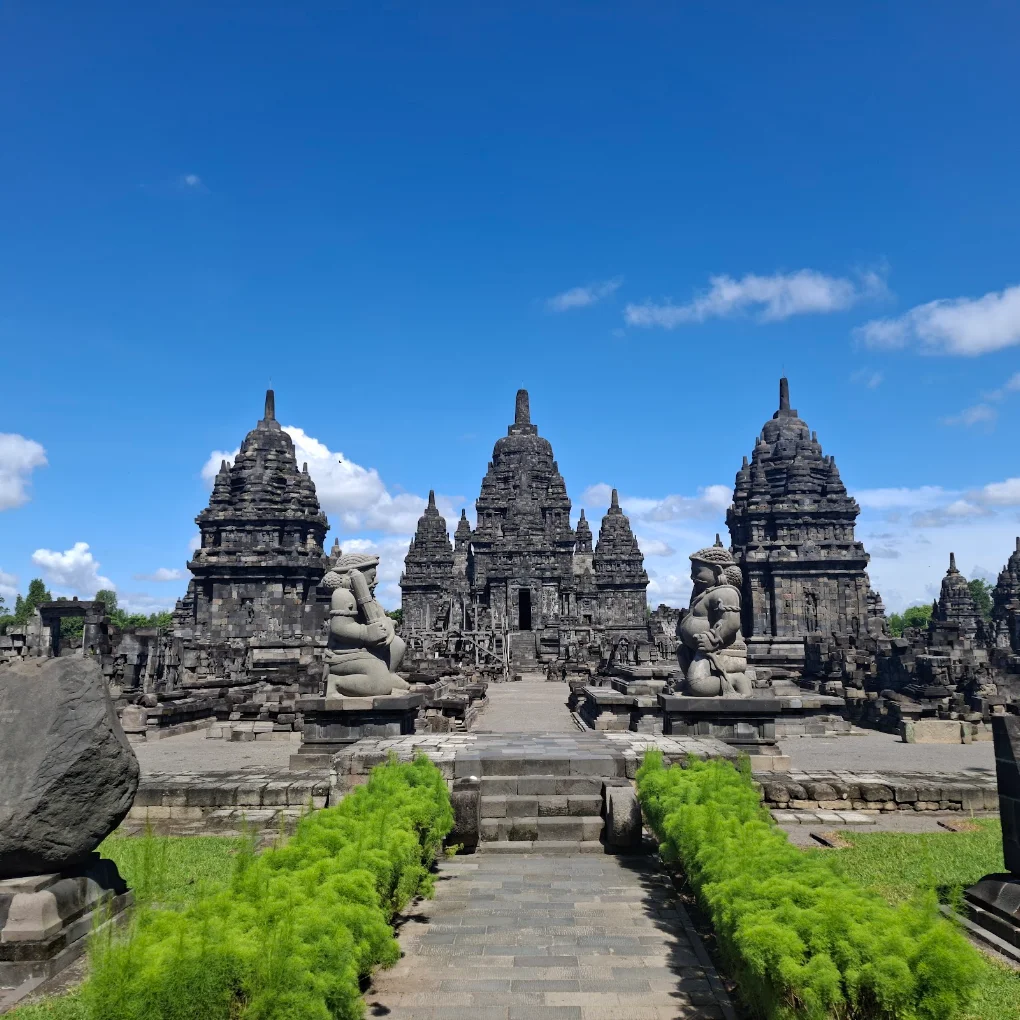
Prambanan Temple Compounds is not just one temple — it is the centerpiece of the Dataran Kewu (Kewu Plain), a fertile corridor between the southern slopes of Mount Merapi and the limestone Sewu mountains. This plain is one of the richest archaeological zones in Indonesia, where Hindu and Buddhist temples stand within a few hundred meters of each other.
Inside the Park
- Candi Sewu — Just north of Prambanan, the second-largest Buddhist temple in Indonesia after Borobudur, dating to around 782 AD. It has one main temple surrounded by 240 ancillary temples and predates Prambanan. Its proximity to a major Hindu complex is powerful evidence of peaceful coexistence between Buddhism and Hinduism in ancient Java.
- Candi Lumbung — A smaller Buddhist temple built around 850 AD. Its name means “rice barn,” a reminder of how later communities reinterpreted ancient structures through everyday life.
- Candi Bubrah — Another small Buddhist temple, rebuilt between 2011 and 2017.
Around the Plain
The wider Dataran Kewu holds some of the earliest Buddhist monuments in Indonesian history alongside Hindu temples: Candi Plaosan to the east; Candi Kalasan and Candi Sari to the west; and to the south, Candi Sojiwan, the hilltop Ratu Boko site, Candi Banyunibo, Candi Barong, and Candi Ijo.
This density of religious sites strongly suggests that the area was a major center of religion, politics, economy, and culture — and that the capital of the Medang Mataram kingdom likely lay somewhere on this plain. Many scholars compare the richness of the Dataran Kewu to other great Southeast Asian archaeological landscapes such as Angkor, Bagan, and Ayutthaya. The side-by-side Hindu and Buddhist temples also stand as an early symbol of Indonesian religious tolerance.
The Prambanan Museum: Don’t Skip It
Between the Prambanan and Lumbung temples, on the northern side of the park, sits the Prambanan Museum — built in traditional Javanese joglo architecture. It is included free with your park ticket, yet many visitors walk right past it.
The collection includes temple stones and statues found around the site: Nandi, Agastya, Shiva, Vishnu, Garuda, and Durga Mahisasuramardini, plus a Shiva lingga symbolizing fertility. Also on display are replicas of the famous Wonoboyo gold treasure — including a bowl carved with Ramayana scenes, a ladle, a bag, coins, and gold jewelry (the originals are kept at the National Museum in Jakarta) — and architectural scale models of Prambanan, Borobudur, and Plaosan. An audiovisual presentation on the temple’s history rounds out the visit.
Festivals and Cultural Events at Prambanan Temple
One of the most exciting things about Prambanan Temple is that it is not a frozen museum piece. Throughout the year, its courtyards, fields, and open-air stages host performances, spiritual ceremonies, and music festivals.
1. Ramayana Ballet: The Temple as a Stage
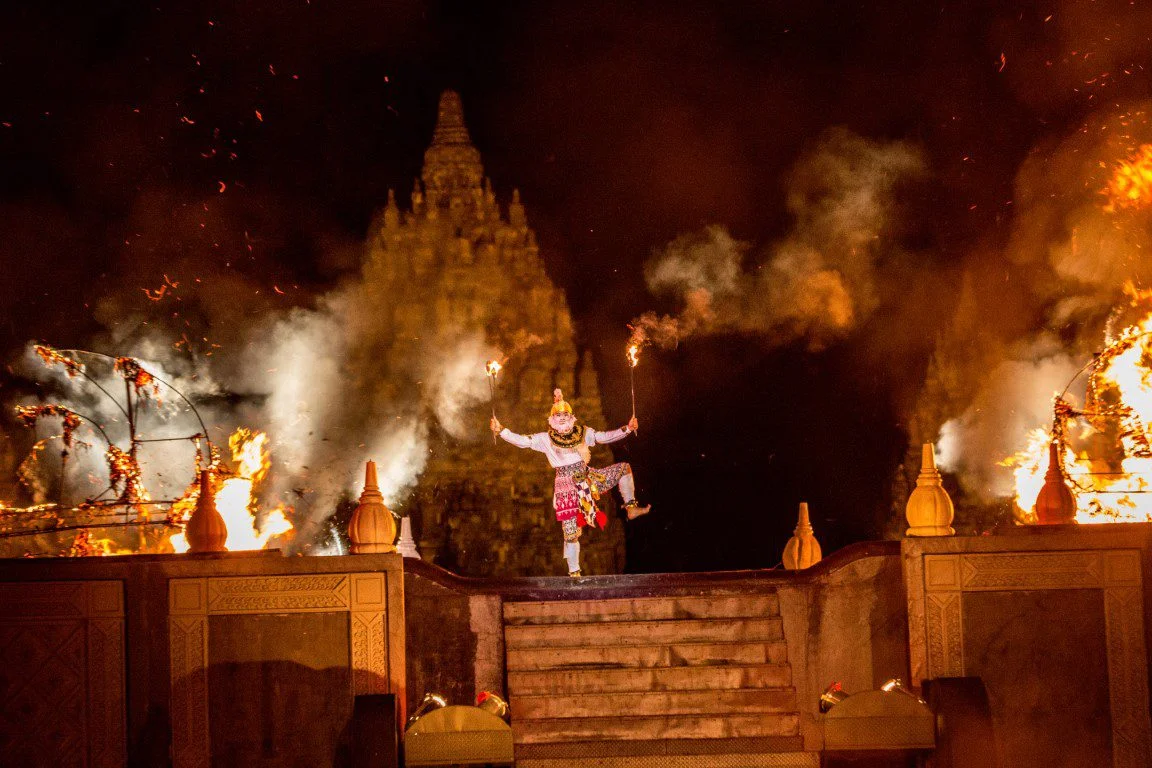
The Ramayana Ballet is the crown jewel of Prambanan’s cultural calendar. It was first performed at the Roro Jonggrang open-air stage in 1961 — a historic occasion documented in photos with Charlie Chaplin and GPH Suryohamijoyo among the guests. Today, more than 200 dancers and musicians bring the epic to life.
Performances run every Tuesday, Thursday, and Saturday at 19:30 WIB. In the dry season (roughly May–October), the ballet is staged on the open-air Trimurti stage on the western bank of the Opak River, with the illuminated temples as the backdrop. In the rainy season, it moves indoors to the enclosed Trimurti Stage. The performance is a Javanese dance-drama (wayang orang) tradition centuries old, adapted into a dialogue-free spectacle accompanied by live gamelan.
2. Prambanan Jazz Festival: Heritage Meets Contemporary Music
The Prambanan Jazz Festival transforms the temple grounds into one of Indonesia’s most atmospheric music venues. The 2026 edition ran July 3–5 and marked the festival’s 12th edition, with a lineup including Michael Learns to Rock, NIKI, The Rose, Tulus, Kahitna, GIGI, and Joey Alexander. Its “Playing Jazz” program invites artists from non-jazz genres — surf rock, indie, pop, hip-hop — to rework their songs into jazz arrangements. Multi-day passes for 2026 ranged from roughly IDR 1.15 million to IDR 2.15 million.
3. Prambanan Shiva Festival: A Spiritual Celebration
Held around Mahashivaratri, the great night of Shiva, this festival reaffirms Prambanan as a national and international spiritual center for Hindus. The 2026 edition ran January 17 – February 15 under the theme “The Month of Shiva for Spiritual, Peace, and Harmony.” Highlights include a midnight Mahashivaratri prayer procession (00:00–03:00 WIB), a Dipa and Damaru Festival with chanting of 1,008 names of Shiva and mass lamp-lighting, cultural parades, art exhibitions, an international conference, and a closing ceremony featuring the Shiva Nataraja dance.
4. Tawur Agung Kesanga: A National Purification Ritual
Tawur Agung Kesanga is a national-scale Hindu purification ceremony held ahead of Nyepi. In 2026, it was held at Prambanan on March 18, drawing an estimated 35,000 attendees. It features an ogoh-ogoh parade of large artistic effigies, later burned or discarded to cleanse negative energies, with the main procession in the Wisnu Mandala courtyard.
Hindus in Central Java and Yogyakarta also gather at Prambanan for Galungan, Tawur Kesanga, and Nyepi each year — a revival of the temple’s religious role that has grown since the 1990s as the local Hindu community (both Balinese migrants and Javanese converts) has expanded.
5. Keroncong Plesiran
Keroncong Plesiran brings traditional keroncong music — a genre with Portuguese-Javanese roots — to the park. The 2026 edition celebrated its 10th anniversary on June 13–14 at Nandhi Field, combining music, art, culinary stalls, and a relaxed outdoor atmosphere.
6. Other Cultural Programming
Beyond the headline events, Prambanan hosts smaller programs under Prambanan Music, Art & Culture, including contemporary puppet theater, dance, and community gatherings. It has even hosted national events such as the IVCA Rally — proof that it functions as a living cultural hub, not just an archaeological site.
A quick tip: Festival dates and lineups change every year. Always check official InJourney Destination Management channels and the Ministry of Tourism’s event calendar before booking.
Visiting Prambanan Temple: Practical Guide
Location and How to Get There
Prambanan Temple sits right on the border between Yogyakarta and Central Java. The complex spans two provinces: the core is in Bokoharjo village, Prambanan district, Sleman Regency (DIY), while the administrative gate is in Tlogo village, Prambanan district, Klaten Regency (Central Java). It lies about 17 km northeast of Yogyakarta and 120 km south of Semarang.
- Trans Jogja bus — Route 1A from Mangkubumi (near Malioboro) to Terminal Prambanan, about 1 hour, then a 1.5 km walk.
- Commuter rail — From Yogyakarta Station toward Palur, about 20 minutes, then a short walk.
- Car or taxi — The most convenient option, especially if you’re combining Prambanan with other sites on the Dataran Kewu.
Opening Hours and Tickets
The ticket window opens every day at 06:30 WIB and closes at 17:00 WIB. The temple area remains open until 17:30 WIB. Ticket prices are divided by nationality and day of visit:
Important visit information:
- Monday closure of the main zone: The central temple courtyard is closed every Monday for conservation. Surrounding areas remain accessible, but the main temples themselves are not.
- Ticket inclusions: One ticket covers Candi Prambanan, Candi Lumbung, Candi Bubrah, Candi Sewu, and the Prambanan Museum.
- Inner chambers: Note that the inner chambers of the main temples have been closed to visitors since 2009 for safety and conservation reasons — you can still admire the exteriors and galleries.
- Online purchase: Buy through the official InJourney Destination Management website or Traveloka for convenience and sometimes lower prices.
- Opening hours summary: Ticket counter 06:30–17:00 WIB; temple area open until 17:30 WIB.
Best Time to Visit
The dry season (April–October) is ideal for clear skies and manageable crowds. April to June offers the fewest tourists. Early morning or late afternoon brings the most magical light and cooler temperatures. If you want the Ramayana Ballet on the open-air stage, visit between May and October. And avoid Mondays if you want to enter the main courtyard.
What to Do There
- Walk the pradaksina — Circle the Shiva temple clockwise and follow the Ramayana panels in their intended order, then continue to the Brahma temple. Don’t forget the Krishnayana on the Vishnu temple.
- Hunt for the “Prambanan Panels” — The lion-and-kalpataru carvings on the outer lower walls, found nowhere else.
- Visit the museum — Free with your ticket, and it explains the restoration and the Wonoboyo treasure.
- Combine with Sewu — A short walk or shuttle ride to the Buddhist complex, already included in your ticket.
- Watch the Ramayana Ballet — Tuesday, Thursday, and Saturday evenings.
- Time your trip with a festival — Prambanan Jazz, the Shiva Festival, Tawur Agung, or Keroncong Plesiran.
Fun Facts About Prambanan Temple
- It was built over decades, not one night. Construction spanned from around 850 AD through the reigns of multiple kings.
- Its original name was Siwagrha. “Prambanan” is a later name derived from the village — possibly a dialect shift of “Para Brahman.”
- There are four other etymology theories, including one linking it to the Khmer words for “five mountains” and one to a Javanese word for gathering leaves.
- The builders rerouted a river. The Siwagrha Inscription records that the Opak River was diverted to protect the temple from erosion.
- A treasure is buried beneath the Shiva statue. A 5.75-meter well contains a stone casket with gold sheets, 20 ancient coins, gemstones, and gold shaped like a turtle, cobra, lotus, altar, and egg.
- It has 240 temples, not 1,000 — 16 in the sacred core and 224 perwara temples in four concentric rows of 44, 52, 60, and 68.
- Only 18 structures survive, and a temple is only rebuilt if at least 75% of its original stones remain.
- It is the second-largest Hindu temple in Southeast Asia. Only Angkor Wat is larger.
- The Vishnu temple tells a different story. Instead of the Ramayana, its panels depict the Krishnayana — the life of Krishna.
- The “Prambanan Panel” is unique. The lion-and-kalpataru pattern appears nowhere else in Javanese temple art.
- Two wahana temples are empty. Neither the Hamsa temple nor the Garuda temple contains its namesake statue.
- The Shiva temple is 47 meters tall — roughly a 15-story building, made entirely of andesite.
- Its design mirrors the universe. The three courtyards represent Bhurloka, Bwahloka, and Swahloka — the realms of mortals, sages, and gods.
- It survived a major earthquake. The 2006 quake damaged the Brahma temple badly; Nandi’s restoration was completed in January 2009.
- It has sat on a provincial border since 1755. After the split of Mataram, the ruins and the Opak River marked the boundary between Yogyakarta and Surakarta.
- It sits next to a Buddhist complex. Sewu, a major Buddhist temple, is just a few hundred meters away — an ancient symbol of religious tolerance.
- The Durga statue has a dual identity. Officially a goddess, locally believed to be the petrified Roro Jonggrang.
- It was rediscovered in 1733 by a Dutchman named CA. Lons.
- The Ramayana Ballet has run since 1961, making it one of Indonesia’s longest-running regular cultural performances.
- Prambanan Jazz has run for over a decade, celebrating its 12th edition in 2026.
- The main courtyard is closed every Monday for conservation — plan around it.
Why Prambanan Temple Still Matters
Prambanan Temple is not just a relic of the past — it is a living, breathing cultural landmark. It is a place where you can trace the genius of 9th-century Javanese engineers who moved a river, read the Ramayana and the Krishnayana in stone, peer into a legend that has been told for centuries, and witness the resilience of a monument that survived earthquakes, looting, and neglect.
It is also a place where heritage meets contemporary life — through ballet under the stars, jazz festivals, Hindu ceremonies, and community celebrations. Whether you’re a history buff, a spiritual seeker, a photographer, or simply a curious traveler, Prambanan Temple rewards you with layers of meaning that unfold the longer you look. It is, in every sense, a masterpiece — and one that belongs not just to Indonesia, but to the world.
Ready to see it for yourself? Book your tickets, pack your sunscreen, and prepare to stand beneath spires that have watched over Java for more than a thousand years.
References and Official Sources
- Wikipedia bahasa Indonesia. Candi Prambanan. id.wikipedia.org
- Balai Pelestarian Cagar Budaya Daerah Istimewa Yogyakarta. Kompleks Candi Prambanan. Direktorat Jenderal Kebudayaan, Kemendikbudristek. museumcagarbudaya.kemenbud.go.id
- UNESCO World Heritage Centre. Prambanan Temple Compounds. whc.unesco.org/en/list/642
- Jordaan, R. (Ed.). (1996). Memuji Prambanan. Jakarta: Yayasan Obor.
- Soetarno, R. (2002). Aneka Candi Kuno di Indonesia. Semarang: Dahara Prize. ISBN 979-501-098-0.
- Ariswara (1993). Prambanan (3rd ed., translated by Lenah Matius). Jakarta: Intermasa. ISBN 979-8114-57-4.
- Rusmiyati, dkk. (2018). Katalog Museum Indonesia Jilid II. Direktorat Pelestarian Cagar Budaya dan Permuseuman. ISBN 978-979-8250-67-5.
- Gunarto, H. (2019). UNESCO Cultural Heritages and Symbol of Indonesian Peace and Religious Harmony. International Journal of Current Multidisciplinary Studies, May 2019, pp. 993–997.
- Raffles, T.S. (1817). The History of Java.
- Slamet, S., Nuryanti, N., Soelistijanto, R., & Bhandari, R. (2026). Socio-Cultural, Historical, Religious, and Architectural Values of Prambanan Temple. Tarbawi: Jurnal Pemikiran dan Pendidikan Islam.
- Inaba, N. (2008–2010). Conservation Engineering Research for Restoration of Prambanan World Heritage Compound damaged by 2006 Java Earthquake. JSPS.
- InJourney Destination Management. Prambanan Ramayana Ballet: Schedule & Ticket Information. injourneydestination.id
- InJourney Destination Management. Keroncong Plesiran 2026: 1 Decade. injourneydestination.id
- Kementerian Pariwisata Republik Indonesia. Prambanan Shiva Festival 2026. event.kemenpar.go.id
- Antara News. 35 ribu orang bakal ramaikan Tawur Agung di Candi Prambanan (26 February 2026). antaranews.com
- RRI.co.id. Pawai Ogoh-Ogoh Warnai Ritual Tawur Agung Nasional 2026 (26 February 2026). berita.rri.co.id
- Inforadar. Jelang Prambanan Jazz 2026: Lineup Lengkap dan Harga Tiket (2 July 2026). inforadar.disway.id
- Traveloka. Tiket Candi Prambanan. traveloka.com
This article was compiled for informational purposes. Ticket prices, opening hours, and festival schedules can change. Always check official Indonesian heritage and tourism channels — such as InJourney Destination Management or Traveloka — before your visit.